
On your blog, reflect on where you started and where you are now in your career. What have been the structural constraints or indeed privileges that have shaped your life? How, if at all, have they influenced your progress in your education or professional development?
Reflect on your own technical capital or lack of it. Has it enhanced your agency? Has anything else enhanced your agency
To begin with, this is quite a timely topic for me right now. I’ve been at my university for seven and a half years, and have just finished a national-level three-and-a-half-year project. Things in our T&L centre are tumultuous right now, and for the first time in a long time, I’m considering other options due to the uncertainty, and the ongoing precarity of my employment. I know I’ll have a lot to say here, so I will try my best to address the theory rather than ranting about the situation!
Structure and Its Impact
It is in fact impossible to account for the structure and functioning of the social world unless one reintroduces capital in all its forms and not solely in the one form recognized by economic theory.
(Bourdieu, 1986)
I began my career as a secondary teacher in 2005, and have not worked outside of education since I was a teenager. I am an educator. It’s part of my identity, and I care deeply about it. My move into higher education was an accident. I took a three-month summer contract at the university to cover someone that kept getting extended, and I obviously had the passion and skillset to do the job. In 2016, I secured a 0.5 permanent contract and have always been topped up with project funding and other creative uses of funding ever since. In the beginning, I felt as though I was being invested in, but as time has worn on, it’s become clear that our local management has decided to invest in more junior colleagues. This has come from a place of fickle favouritism. I’ve been told it’s because they have families ( I’m single with no children, so I don’t have the same responsibilities) though I do have caring and financial responsibilities for two relatives. And yes, I know this is unethical and bad practice, but reflecting on the situation will help me reflect on my own capital.
Since my teaching career, my lack of cultural capital has often caused me to be passed over. In Ireland, having stature in the community trumps academic achievements. I would have been much more employable in a school if I had been involved in sport (GAA), music, or been a part of a prominent family. I actually had a principal ask me who my father was once, and it genuinely took me a minute to get my head around the question because it was so unexpected. At the time, the teacher who I was covering for was the daughter of a local builder, with brothers very active in sport and the community. I had initially thought I’d left this barrier behind in higher ed, but now I see it creeping back in as others are seen to ‘need’ the job more than I do due to family circumstances.
I am the only child of a single mother, I call her that because my parents divorced when I was young. She sacrificed a lot to ensure that I had an education, but when I wanted to pursue my PhD in my 20s, my precarious contracts and lack of family support proved to be a barrier. I couldn’t manage it financially and was overwhelmed with other responsibilities. I am attempting to self-fund this course because I don’t want to let my manager know I’m doing it, and I’m conscious that if I leave my job I won’t have to owe anything back to the university.
Proving that history does repeat itself, my mother and I moved to the States when I was a teenager after she lost her teaching hours in the local school. They were given to a woman from a prominent local family, and because we had an American connection, the principal told my mother that she’d be better off, and the similarities to my current circumstances are eerily and infuriatingly familiar.
Yet in being as open about all of those personal circumstances, I’m hyper-conscious that I have all of the privileges of a white woman with a decent education in a relatively well-paying job, and I’m also conscious that while I’ve struggled due to structural constraints, I also posses some cultural capital due to my education. That capital is what most removes me from the rural Ireland and the community where I live and elevates me toward the academic space, yet I’m also aware that I don’t posess quite the cultural capital to truly ‘be’ an academic, and thus I occupy a third space like many in my field do.
Capital
Maton comments, ‘This equation can be unpacked as stating: one’s practice results from relations between one’s dispositions (habitus) and one’s position in a field (capital), within the current state of play of that social arena (field) (2014: 51).
Based on the readings this week, and my rushed attempt to put my critical hat back on, I’ve realised that much of my own capital, be it social, cultural, or symbolic has been cultivated and earned over time, and has certainly changed throughout my career. I’ve been labouring over this post more than necessary, and I think it’s because I’m trying to unpack everything into neat sections covering the terminology, when in reality, these concepts will eventually underpin the critical reflections in these blog posts and help me to analyse my practice with a new depth.
But to return to the point, my technical capital is a bit complicated. I come from a background where I didn’t have access to a computer until I was nearly finished with school. In fact, when we moved to the States and all school projects and papers had to be typed, my mother would take me to the library where she would type my handwritten work while I wandered around. She taught typing, so it was quicker for her to type the work to make the best use of the limited computer time we had. When we finally got a home PC, it was because she paid on that 8GB IBM over monthly so I could have it. I also have very little formal training in technology, and have been largely self-taught since we got that PC. I know from experience that I am on par or even ahead of colleagues in relation to my skills, but it’s not always seen that way due to my teaching background.
Agency/Structure
I find that the tension between agency and structure resonates with me, and while I’ve often focused my own work on nurturing and support the agency of the staff and students I work with, it’s useful to have to reflect on my own. While I’ve outlined many of the barriers I’ve faced in my own career in this post, I also have some affordances. I’m earned a certain amount of freedom because I simply do good work and work hard, and it’s understood that I’m truly interested and passionate about what I do.
At the same time, some of the more operational work I do isn’t of my choosing, and certainly doesn’t align with my values. For instance, I was recently told I’d be leading our Learning Technologies team on the move from Blackboard to Canvas. I’m not particularly interested in any corporate VLE, and I’d love to do more critical research about Instructure, but at the end of the day, our T&L committee have made the decision, and it’s my role to support it. I’ve decided that a pragmatic approach is best, and that I can keep my crtical hat on while still supporting our staff during an uncertain time.

To varying extents, I’ve always felt bound and constrained by the structures imposed on me by others. In light of that, and due in no small part to my salad days as a punk rock teenger, two of the movements that most closely align with my own practice are Edupunk and Domain of One’s Own. To rally against the structure, I practice what I preach at least personally. I have a personal site hosted by Reclaim Hosting.
In 2019, I began to explore H5P and agency I wanted to introduce more open tools to our repetoire and thought it was a more flexible antidote to the pricier packages. I thought it was better for staff to invest time in a tool that was usable in any context with our without a license, and to be able to take reusable files with them. I presented about this half-baked idea at the OER19 Conference in Galway and was shocked by the positive response from people I really respected.
Social (Media?) Capital

This is an area that I know will come up again at some stage during this course, and I still find it a bit perplexing. I’ve been on Twitter for years, and while not as active anymore, I often find that I am ‘known’. I’ve done a lot of conference organising, Virtually Connecting, and been part of a national project, so I guess there might be some reason as I’ve been a bit ‘out there’, but it still baffles me. I often question the reality of it all – does being known even matter? What is the value of being known in certain communites? Does it enhance my capital? Has it given me agency?
Final Thoughts
Sincere apologies for this meandering post this week, but I think it’s been helpful for me to document my current place both professionally and personally. To sum things up, being so conscious of structures and barriers has helped me to be become so values-centred. Ultimately, much of my work has focused on humanising design approaches, and empathetically supporting staff using a pragmatic approach. I know that tech won’t save anyone, and that while digital offers great affordances in many cases, we must be led by values.
…and remember…
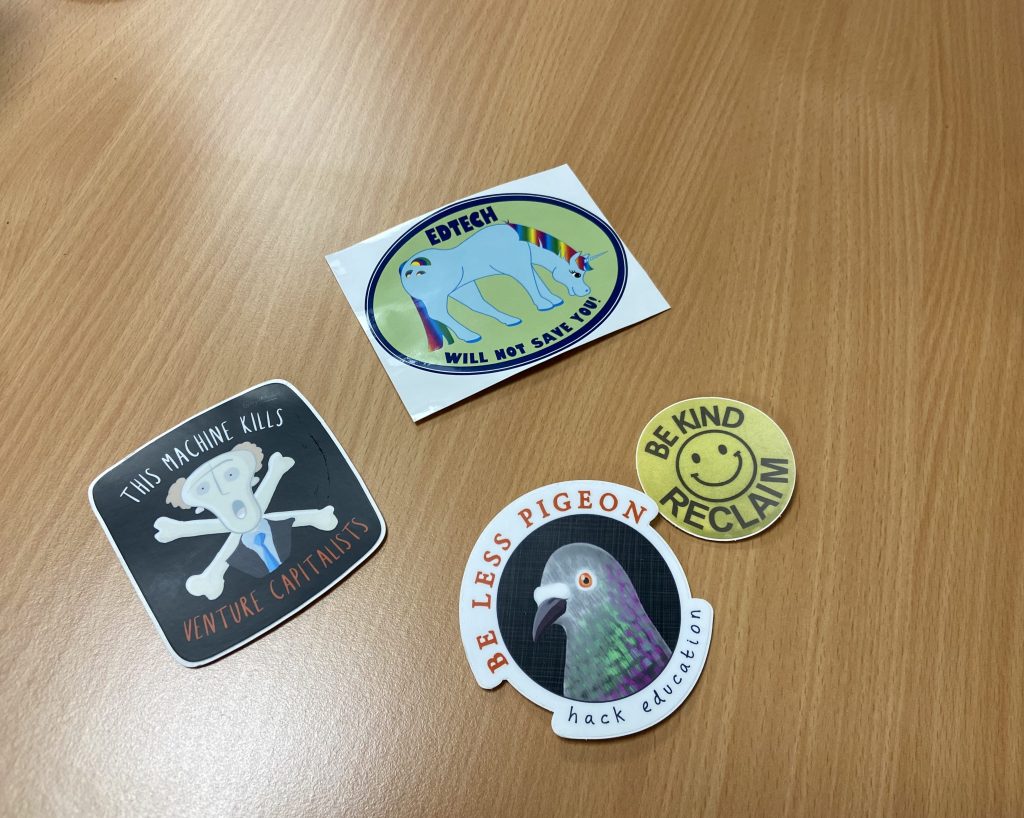


Thank you for putting the blog task at the top of your post – that’s quite useful for me and hopefully helped you to keep your focus?! Such an interesting and varied first post and some great use of multimedia.
You say:
‘In Ireland, having stature in the community trumps academic achievements.’
Fascinating analysis of the conflict between cultural and social and economic capital in Ireland. Yes, this happens in the part of Scotland I originally hail from – Wick, Caithness. My Grandad was the Harbour Master/local councillor/business owner etc so Dunnett family had high standing. He gave a lot to the community which was transferred to the rest of his family as social and economic capital!
I can totally relate to your lack of interest or in fact dread of the move from one corporate VLE to another. I worked as a Learning Tech at Sheffield University for 10 months and this was one of the jobs I was involved in – I’ve never been so bored in my whole life – that’s why I only lasted 10 months! Like you, I was interested in the educational affordances, not all the technical guff. Really academic term there!!
Your links to Edupunk and Domain of One’s OWn are interestingly aligned with our MSc programme. The university VLE is Blackboard Learn but the MSc in Digital Education has used a variety of other platforms to teach courses – Moodle, WordPress, Google Sites and Tumblr for example. We also use other virtual environments as part of our courses – Second Life (until 2013), Minecraft, Twitter, Mozilla Hubs. Thanks for providing hyperlinks to your own website and other sites of interest to this discussion. Good referencing practice!
Do remember to refer to ‘Opening the Closed: Introducing H5P to the Virtual Learning Environment’ again when we get to the weeks on Open Learning Resources – so relevant to the discussions we have then.
Regarding the final section of your post on social capital – I think what Bourdieu is referring to is exactly what you were discussing in your experiences in Ireland – your standing in a community is your social capital. You have gained more social capital in your online and Twitter community which enables you to have influence and maybe offers you opportunities that other, less connected people would have. Might be worth reflecting how your technical capital – your ability to use social media effectively – has improved your social capital in a way you were never able to achieve in Ireland?
In summary, your technical capital has been acquired through your increasing economic, cultural and social capital – they’re all intertwined aren’t they? I find Halford and Savage (2010) discussion of the feminist critique re technical capital quite interesting too – they say:
“…science and technology are produced by, and constitutive of, masculine identities and male power” (p.941).
What do you make of that? I’d be interested to hear your thoughts.
Thanks for your comments, Noreen. I knew coming in that this programme would align well with my own ethos and values, and I’m happy to see the variety of platforms in action!
“Regarding the final section of your post on social capital – I think what Bourdieu is referring to is exactly what you were discussing in your experiences in Ireland – your standing in a community is your social capital. You have gained more social capital in your online and Twitter community which enables you to have influence and maybe offers you opportunities that other, less connected people would have. Might be worth reflecting how your technical capital – your ability to use social media effectively – has improved your social capital in a way you were never able to achieve in Ireland?”
That’s a really interesting point. I hadn’t really considered a social media presence to have too much technical capital, but I suppose it does given my skill in using/leveraging it. There are different attitudes to social media presence in our department, which is why I vacillate about its worth. It certainly has helped me achieve a level social capital that I was never able to without it. It doesn’t always help to ease any anxiety about imposter syndrome, though. I always feel a tension between how I’m perceived externally and my more private self.
“In summary, your technical capital has been acquired through your increasing economic, cultural and social capital – they’re all intertwined aren’t they? I find Halford and Savage (2010) discussion of the feminist critique re technical capital quite interesting too – they say:
“…science and technology are produced by, and constitutive of, masculine identities and male power” (p.941).
What do you make of that? I’d be interested to hear your thoughts.”
*I actually intended to explore this more, but I’d already written way too much. I even drafted a second post that I might finish at some stage. Again, I notice a strange tension in our field between those that can do the technical/design piece (seen as real work) and people like me that gravitate toward soft skills (pedagogy, learning design, critical approaches, not real work). I’d never considered that it had patriarchal underpinnings, but that seems so obvious now. Going back to my recent project work, I’ve had many colleagues of both genders sneer about our accomplishments as much of it was focused on creating resources, writing, webinars, outreach, etc. I even had to put together a timeline of achievements to help justify that I did things! This is really helpful. I’ll have to apply this lens in my posts going forward.
Do add another post on the feminist perspective if you want – it could just be a short one – 300 words or so?