
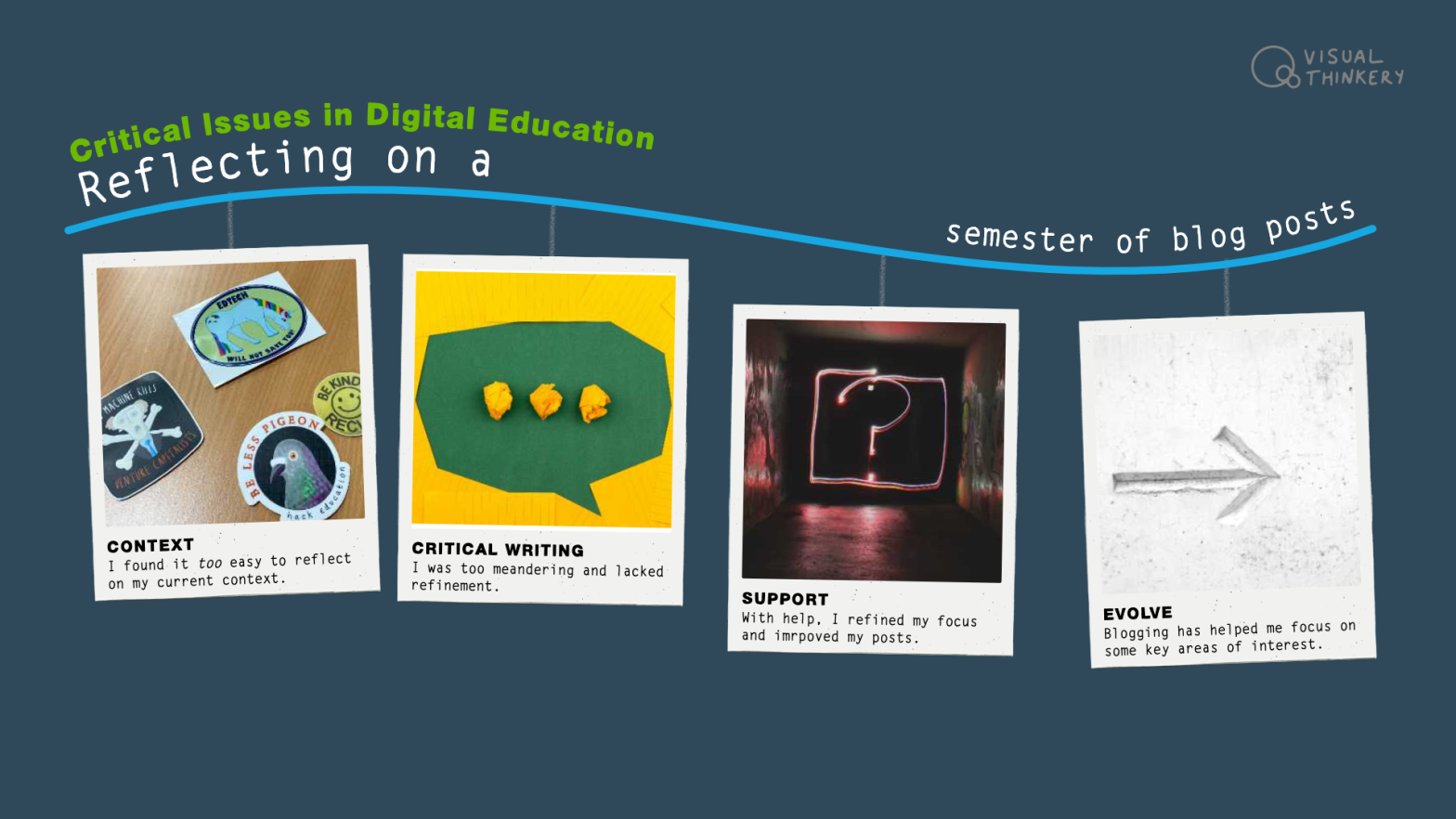


“Edinburgh application” sat on my to-do list last semester for many months. My collaborator and friend, Clare Thomson, spoke so highly of the course and team, but I had hesitations given how long it had been since I pursued any formal CPD. When I finally took a few days off before Christmas, I hastily submitted the application and was shocked that it was processed so quickly, and before I could overthink it, I was registered for this course. The timing was truly terrible. I had been tasked with leading our migration from Blackboard to Canvas, and I was actively job hunting. Somehow, I managed seven job interviews and the accompanying presentations, my day job, and the course.
While the semester hasn’t been light work, it was actually an interesting time to work through the various blocks as I navigated a new VLE. I was busy carefully considering settings and functionalities, procuring and installing external tools, and carefully examining data and privacy policies. I do apologise for being so wordy in my early posts, but as you might imagine, I was reflecting a lot internally, and it happened to overspill on the digital page a few times!
Responding with short posts (such as these on Teacherbot and gender) to Noreen’s comments was helpful as I was able to narrow in on more critical, specific elements of the block. I found it hard to ‘not blog’ in a blogging space.
I noticed that my post on AI was where I started to refine my writing, and it’s interesting because it was the least personal block thus far. At that point, and with the dialogue happening in the comments, I felt best equipped to critically reflect on the course content. Also, covering the wide variety of critical perspectives in the course content has helped to further expand my own critical positions.
I also managed to secure a new job, and I’ll finally be full-time permanent after fifteen years of precarity. Throughout the semester, as the job offers came in, I began to consider my work and critical position beyond my institution. This course gave me a space to reflect and consider that position. I was able to connect with others in the forums, and Noreen here on the blog. Michael was also so helpful when I had reservations about my writing.
Overall, I wouldn’t say that my position has changed as much as it has been reinforced and refined. I would have registered for this course even if it wasn’t mandatory as it would be of interest. I feel as though I initially struggled to refine my argument around themes like structure/agency and affordances because I trying to address too much, and I might have been better off if I adopted different lenses to address those issues, such as examining agency through practice or affordances through digital literacy and competence.
I’ve also taken some time to look over the course readings again, and I’ve noted which articles and reports are the most highlighted. Facer and Selwyn’s (2021) paper on digital technologies and ‘non-stupid optimism’ stands out, and I’m not surprised given its pragmatic analysis of the history, and future, of technology in education. While I have many passages highlighted, I’ll draw on this quote to share some final thoughts:
However, it is no longer acceptable to turn to education technology naïvely and without recognition of the mixed outcomes of the past. As our previous instances of technology use in education suggest (from Logo to COVID remote schooling) a ‘technology-first’ mindset is not a helpful way to address the question of how digital technologies might usefully play a part in establishing more equitable, responsive and sustainable forms of education.
(Facer and Selwyn, 2021, pp. 10)
As I reflect on my work as a teacher and then learning technologist, I’m reminded of those ‘mixed outcomes’ noted in the article. My own values have shifted over time from naïve to critical, and from practical to pragmatic. Ultimately, I’ve learned through my work, reinforced by the trajectory of this course, that I am both academically and practically invested in how digital technologies might establish more “equitable, responsive and sustainable forms of education” (pp. 10), and these values are truly mine, and not tied to an institution.
References:
Facer, K & Selwyn, N 2021, Digital Technology and the Futures of Education: Towards ‘Non-Stupid’ Optimism. UNESCO, Paris France. https://unesdoc.unesco.org/ark:/48223/pf0000377071
Molloy, K. 2023. “Storyline by Visual Thinkery remixed by Kate Molloy”. Available at: https://remixer.visualthinkery.com/r/xHUfxsnq6yiL2IsMFfo7. (Accessed: April 1, 2023).
Succinct, reflective and incisive analysis of your own progress over the past few months!