
While it is certainly promising to see computing well-covered in the national curriculum in the UK, it is unclear how the computing skills covered in the curriculum serve to foster digital literacy, itself being a truly complex concept to unpack.
Pangrazio’s article quickly outlines the complexities surrounding a more critical digital literacy:
Indeed, the multiple forms of critical digital literacy reflect the array of academic disciplines involved with this area of research and their different theoretical underpinnings and goals. Against this backdrop there is clearly a need for continuing to challenge and test what we mean by critical digital literacy in the complex, contemporary digital landscape.
(Pangrazio, 2016)
Considering this, it’s disappointing that a quick CMD+F search for “literate” in the National Curriculum on computing only highlights one mention of digital literacy in the introductory section of the document.
The UK government says “computing also ensures that pupils become digitally literate”.
National curriculum in England: computing programmes of study (Department for Education, 2013)
While it’s encouraging to see such a detailed focus on computer science in the national curriculum, it’s equally discouraging to see digital literacy covered at such a cursory level. While the curriculum outlines the need for understanding safety, acceptable use, and respect, it fails to link these digital literacies coherently to the skills covered in each key stage. How will computing ensure that students become digitally literate?
Emejulu and McGregor’s article on radical digital citizenship delves deeper into the socio-materialist and socio-political underpinnings of technologies and movements in the Global South and North, inviting the reader to consider some inconvenient truths. The article should provoke educators working in this space. How can we best serve students in a landscape where we are often ignoring the darker underbelly of the technologies we use and the critical skills we hope to instill? Can we teach students computing fundamentals in an ethical way? How can we highlight the hidden curriculum at the core of technologies we use every day?
Indeed, digital literacy is a much more complex concept. A few years ago, I was part of a project team led by our department for developing a framework and open resources to improve staff and student digital skills and literacies, the All Aboard! project. The team ultimately designed interactive lessons and curated other resources that any user could complete to receive a digital badge. My colleague, Blaneth, developed this metro map framework to represent the broad clusterings of skills that emerged within the project, and the map became a central metaphor for the work. At the time, we focused quite a bit on technical aspects of areas we take for granted, like how our smartphones work, digital images and video, and online identity. These resources could be embedded in any form of teaching and learning, and have been reused widely.

In our higher ed context, this was a solid start, but nowhere near sufficient to aid students or staff in developing critical digital literacy, unless of course they were so inspired to continue the journey independently! I was reminded of the metro map as a metaphor after the readings this week, I think it visually represents some of the complexities of digital literacy in a similarly messy way.
It also provides an interesting comparison to the national curriculum given the wide array of tools and spaces that the map covers. While it’s understandable that the national curriculum is tool/technology agnostic in its language, it’s worth acknowledging that the technology, tools, and methods that the teacher ultimately uses in the classroom to teach computing will not be neutral.
Key Stage 4 stood out to me as it seemed to address higher-level skills that more specifically foster digital literacies.
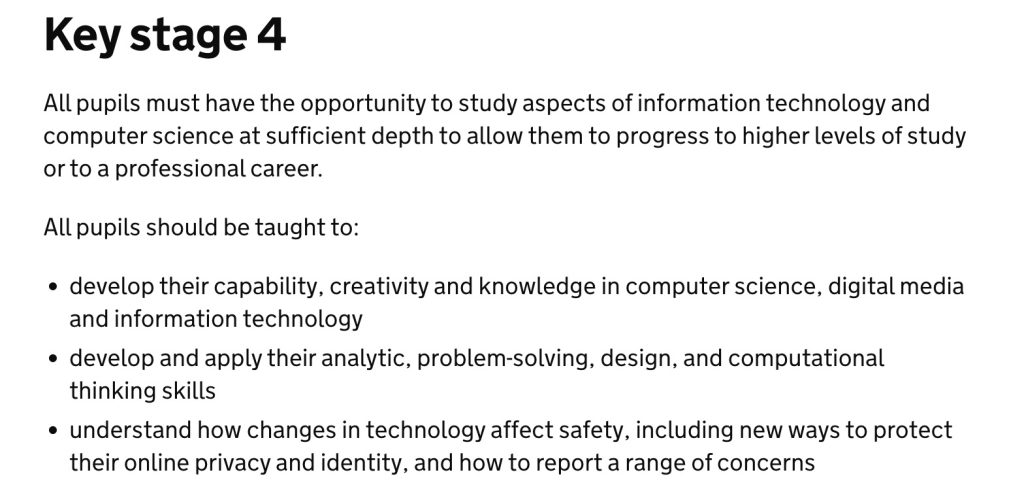
I was surprised to notice that this stage focuses on ‘sufficient depth’ that would allow students to progress to higher levels of study or employment. Personally, I would view these as fundamental skills upon which digital citizenship would be grounded. As Emejulu and McGregor argue:
This is why we argue that a radical digital citizenship must be predicated on relational understandings of materialities: understandings which work relentlessly to expose the raced, gendered and classed bodies masked by the digital fetish.
(Emejulu and McGregor, 2016)
There is so much more depth required beyond the skills addressed in the curriculum, yet no obvious link between the act of the coder or maker and the ethics of what is produced.
I’m personally struggling with what seems like this missing link between the competencies covered in the national curriculum and the inherent biases that humans can code into technologies. I’m reminded of Ruha Benjamin’s Race after Technology. The author provides a short overview of her work below:
Benjamin’s work covers emerging technologies as well as their history, acknowledging that technology is not neutral. While there is much more to address beyond the confines of a blog post, it’s worth grounding these reflections based on practice:
Practices spread across digital contexts and include social, cultural and political elements. Seen in this light, any attempt to foster critical digital literacy with young people needs to reconcile these binaries.
(Pangrazio, 2016)
In order to foster critical digital literacy with young learners, it’s crucial to embed the contextual underpinnings of the tools we use, the movements we follow, and the artefacts we create. It is nearly too easy to criticise the national curriculum, and indeed other documents and frameworks for what they lack. Rather, the missing links should fuel our conversations. If we are to foster critical digital literacy, we should examine the social, cultural, and political elements missing from the national curriculum, or indeed other frameworks we use.
References:
All Aboard! Begin your digital journey. (2015) All Aboard! Available at: https://www.allaboardhe.ie/ (Accessed: February 26, 2023).
Akwugo, E. and McGregor, C. (2019) Towards a radical digital citizenship in digital education, Critical Studies in Education, 60:1, 131-147, DOI: 10.1080/17508487.2016.1234494
Department for Education. (2013) National curriculum in England: Computing Programmes of Study, GOV.UK. GOV.UK. Available at: https://www.gov.uk/government/publications/national-curriculum-in-england-computing-programmes-of-study/national-curriculum-in-england-computing-programmes-of-study#key-stage-4 (Accessed: February 19, 2023).
Pangrazio, L. (2016) Reconceptualising critical digital literacy, Discourse: Studies in the Cultural Politics of Education, 37:2, 163-174, DOI: 10.1080/01596306.2014.942836
“Ruha Benjamin Discusses ‘Race After Technology.’ Available at: https://www.youtube.com/watch?v=rY8RkET3KC0. (Accessed: 26 February 2023).


You make a very pertinent point when you say:
‘There is so much more depth required beyond the skills addressed in the curriculum, yet no obvious link between the act of the coder or maker and the ethics of what is produced.’
Do you have some suggestions as to how this could be achieved? How could the ‘design turn’ (Pangrazio, 2016 p.166) by used for example – where learners are encouraged to ‘unpack and examine the process of design’ – perhaps in the learning of computing or digital skills? Pangrazio (2016) talks about involving learners in becoming ‘producers’ to help instil positive, more equal literacy practices. Could your team design tasks for students to practice skills but produce a product for others and have to consider the impact and needs of the target audience, who they might be leaving out and so on?
I was also really interested in Emeljulu (2019) ideas about radical citizenship and how critical digital literacy could be more collective in approach – people coming together to take action and become involved in ’emancipatory technologies and technological practices’ (p.131). Could this be achieved in your professional context?
ACADEMIC WRITING TIPS/MULTIMODALITY
Thanks for the embedded video – interesting and pertinent.
1. Don’t forget to include the date when you mention a source inline e.g
‘Pangrazio’s (2016) article quickly outlines the complexities….’
and then after the actual quotation just include the page number (so don’t need to include Pangrazio (2016) again e.g
‘…what we mean by critical digital literacy in the complex, contemporary digital landscape’ (p.164)
2. All direct quotation should include a page number after it.
Thanks for your comments, Noreen. Apologies for the referencing issues, I’m quite rusty but very happy to have the opportunity to perfect things based on your comments throughout the blog posts. I’ll be in a much better position to take on the assignment!
In a practical sense, I think there is so much that could be applied from the learning design approaches that our team uses daily to facilitate more critical making experiences for students. Creating without criticality, or even without a planned evaluation or reflective approach in mind is nearly reckless, yet I understand why there is a focus on skills in the classroom with only a nod to criticality. In the Irish context, we have limited resources, time, teachers, and a curriculum to ‘get through’.
I do think radical digital citizenship is achievable as a more collective approach, but it needs the support of management and a willingness for staff to do some deep self-reflection. For example, one of the reasons I had so much to say about platforms and our VLE migration is that the process has effectively upturned our unit’s values. While we always supported the institutional tools, we always equally supported Domain of One’s Own and rewilding. As the VLE migration is happening at a difficult time, it’s obvious that we are being prompted to be less critical and champion the new system. We also have new staff who haven’t had the same mentorship around critical and open practice, and an obvious division in values is becoming apparent. I do believe that in the right circumstances, T&L centres could lead on critical digital literacy.
Thanks for this thoughtful and detailed response to my comments and questions. I totally understand the pressure to ‘champion’ a particular system as in both my jobs as an ed tech/digital ed consultant in schools and at a university I was also encouraged to promote the use of Office 365 and Blackboard. I think that is why I am enjoying the relative freedom from that in my more academic role now!