
“It is precisely in this way that an uncritical championing of openness fails to adequately analyse educational closures.”
(Bayne et al. 2015. pp. 247-250)
In the forums for this block, Jeremy Knox posed the question: “What do you think Bayne et al. (2015) mean by educational ‘closures’? And what has that got to do with ‘openness’?” I had highlighted the quote in my reading, as I found myself struggling to find the ‘openness’ in the course I am currently taking.
For the purposes of this block, I chose the Inclusive STEM Teaching Project MOOC on edX that started just as this block did as it was of interest to my work on inclusion. The course was created by Boston University and spans six weeks to help instructors develop inclusive learning environments in STEM subjects. Aside from the asynchronous content, reflective activities, and discussion board topics, it also provides participants with the chance to join interest groups based on identity. I have dabbled with these course platforms in the past and found the discussion spaces to be generic and not very reflective of a learning community.
The course was created as part of a research project with the National Science Foundation in the U.S. and it’s admittedly very well-designed. A quick Google search of the project team indicates that everyone is U.S. based, which isn’t surprising as it’s a funded project with the NSF, but the course has a clear Global North perspective. As Hodkingson-Williams and Trotter (2018) question: “Might the proliferation of OER from culturally privileged regions lead to even greater inequalities in the global cultural sphere, as students and educators in low-resource environments become inundated with (and/or reliant upon) “free” OER from more highly resourced contexts?” (pp. 212) It’s worth considering that this well-designed course on inclusive teaching with CC-licensed materials might be perpetuating other types of closures.
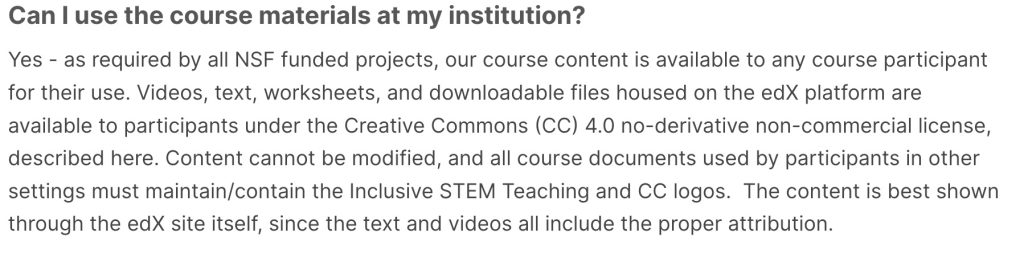
As evidenced above, while the course materials are Creative Commons licensed, they aren’t remixable, so there isn’t currently a way to remix or adapt them to provide a more global perspective or contextualise them for other cultures. While licensing and opening materials is a positive step, it’s worth noting that while they are open materials, they are closed to truly promoting social justice, equity, or sustainability in relation to their licensing.
In this conversation with Stephen Downes (2018), Sukaina Walji outlines the correlation between OER and MOOCs from her role as project manager and researcher. She offers a pragmatic critique of MOOCs as OER. (Note: The creator of the video will not allow it to be embedded elsewhere).
There is also little opportunity to interact with others outside of the forums or affinity groups, which meet synchronously. I haven’t participated due to the time difference as they are in the late evening (8 pm), which would be an obvious barrier for international participants. Again, the course is quite obviously geared toward U.S.-based participants. While the discussion forums are another means to participate, they also fall short of promoting community. While there are many active posters, it is clear that some participants are not posting in their native language and aren’t being included in the richer discussions based on this barrier. While the course is designed with high-quality content, it does not significantly address barriers to building a course community. Tressie McMillan Cottom (2015) outlines the social aspect of online and distance learning in her ICDE keynote:
The course design is obviously tailored towards learners that have participated in higher education previously. Participants can complete the course and get something from it if they are in this category and are motivated to complete it. As Bayne et al. (2015) outline: “Many approaches to open education have been guided by the assumption that students fall into a universal category of rational, self-directing, and highly motivated individuals.” (pp. 247-250)

As someone working in ed tech, I can accept the design of the reflective activity above. The platform likely has limitations, but it serves to highlight that the motivation to engage is very much on the learner. Students have to be self-motivated to participate when there is no requirement to submit thoughtful, accurate reflections.
The course also has a specific intended audience. It is for STEM educators across the sectors that are critically thinking about inclusion in their classrooms. It would be of great value to someone lacking CPD opportunities in their local context. However, it’s limited by its context and licensing. Though well-designed, it still has limitations in its hegemonic design and licensing, and thus remains more closed than open.
References:
Bayne, S., Knox, J., & Ross, J. (2015). Open education: the need for a critical approach. Learning, Media and Technology, 40(3), pp. 247-250.
Downes, S. (2018). Conversation with Sukaina Walji and Cheryl Hodgkinson-Williams. Available at: https://www.youtube.com/watch?v=3sY6M58v3Pg (Accessed 19 March 2023).
Hodgkinson-Williams, C. A., & Trotter, H. (2018). A Social Justice Framework for Understanding Open Educational Resources and Practices in the Global South. Journal of Learning for Development, 5(3), 204-224.
Inclusive STEM Teaching Project. (2023). Module 1: Diversity, Equity, and Inclusion in Teaching and Learning. Available at: https://learning.edx.org/course/course-v1:BUx+INCLU1x+1T2023/home. (Accessed 19 March 2023).
Inclusive STEM Teaching Project. (2022). Module 1: Introduction. Available at: https://www.youtube.com/watch?v=MXhkyj5zuTQ (Accessed 19 March 2023).
McMillan Cottom, T. (2015). The access paradox: Can Education Expansion balance Access with Equality? Keynote speech at ICDE World Conference. Available at: https://www.youtube.com/watch?v=MQV29czVN-w&t=1053s (Accessed 19 March 2023)
Weller, M. (2021) Chapter 11: 2004 OER. 25 Years of Ed Tech: The Serialised Audio Version. [Podcast]. 18 January 2021. Available at: https://25years.opened.ca/2021/01/18/chapter-11-2004-oer/ (Accessed 19 March 2023).


I do hope that I’ve fully improved my referencing in this post, Noreen. Your comments have been helpful. I do want to explore more on the theory from the previous weeks in relation to open, maybe in an additional post. It was useful to focus solely on the MOOC and the associated readings here to refine some thinking on open education. I’m still teasing out ideas for the assignment, so it’s helpful to keep writing.
I really like the way you started this post with a quotation about openness and educational closure, using it to structure your own thinking about this topic. Your writing is developing well and is a pleasure to read – fluent, personal and vivid.
Your review of the MOOC you are involved in, coupled with the embedded video (I especially enjoyed the Tressie McMillan Cottom one), screenshots (appropriately labelled and attributed) is well argued, makes excellent use of your own experience and professional expertise and enlightening in terms of how you apply concepts of openness and closure to it. Nice link to the Downes (2018) conversation with Sukaina Walji as well.
This is really excellent reflective thinking and academic writing Kate – well done.
Your referencing is fine in this post Kate. Glad you’re finding the feedback helpful – you are such a strong and reflective writer I just want you to have all the academic writing skills!!
Thanks for your comments, Noreen. It’s been so helpful to use this blog as a space to start writing and reflecting again.