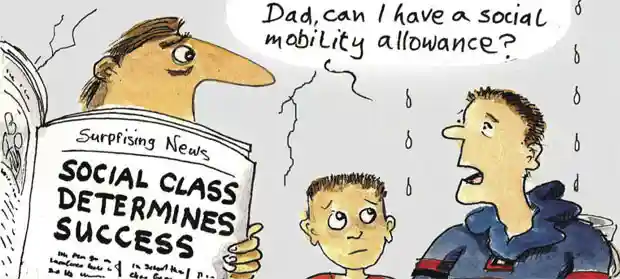
Illustration by Ros Asquith. Retrieved from: https://www.theguardian.com/education/cartoon/2009/jan/27/lines-cartoon
Having reading about Pierre Bourdieu’s theories on class inequality and the perpetuation of social class through the educational system, it’s challenging not to reflect on my own life. As per Bourdieu words, I was born with no social or economical capital. Neither my maternal grandparents nor my parental grandmother were literate. Additionally, my father never met his father and had to carry the stigma of being born out of wedlock. His life was hard; he started working at the age of 9 and he pursued secondary education through night classes. He didn’t do well academically and nor did he pursue a university degree, embracing a lifelong career as a blue-collar worker with limited prospects and long periods of unemployment. My mother didn’t complete high school and spent her working life as a seamstress and cook until retirement. Yet, by pure chance, both were exposed in certain way to the dominant cultural capital. My maternal grandmother worked as a cook, and my father spent part of his childhood in the kitchen of a wealthier family. Moreover, my mother had a successful uncle residing in a more affluent area of Santiago. This exposure might have sparked ambition in both of them for my siblings and me. We all pursued university education, earning degrees and jobs that eased our lives.
My sister and I attended an under-resourced school where each classroom had 45 students. Despite having well-intentioned teachers, neither they nor the school actively promoted Biesta’s educational ideals nor the Bloom taxonomy of learning. My eldest sister decided to become a primary school teaching due to not meeting the grades required for nursing. Opting for English over Literature, I anticipated better career prospects. While my sister attended a modest university in a small Chilean town and now teaches in a working-class neighbourhood. I enrolled in a state university known for its wealthier student base. This path, I believe, transformed my life, granting me social and cultural capital, aligning with Bourdieu’s theory. I went to work in a private school, making more money but never feeling that I had the social capital or cultural capital to keep working there. Having said that, I’m certain these experiences, gave me the ambition to explore other opportunities, not to mention the positive influence of some of my teachers. However, sometimes I wonder who I would be right now if I hadn’t been born into a different social class with more social, cultural and economic capital.
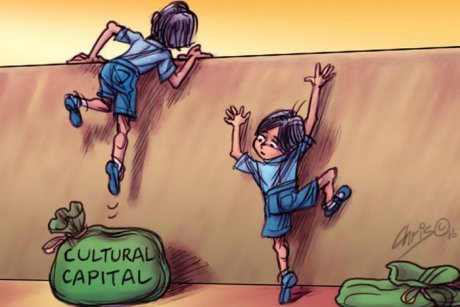
Retrieved from : https://www.carlisleinfantschool.co.uk/page/?title=Cultural+Capital&pid=308
It is impossible not to agree with Bourdieu about how inequalities are perpetuated through the school system. On one hand, public education has been hijacked by the constant idea of testing and the belief that performing well in those tests is synonymous with intelligence and potential. It appears that there is a lack of education or subjectification, as per Biesta’s ideas. If students with less economic capital are fortunate, they will attain a certain level of qualification and socialization due to their social interaction with their classmates and teachers. However, due to existing social segregation of education, there is not only a divide between private and state schools but also among the social classes to which students belong, so one could argue that this socialization might be partial.
In my own experience, I went to a state school where everyone was like me, and then at university, I only socialised with students who came from the same social background. At university, clearly those who came from private school were academically and socially ahead of any of those who came from a state school background, so there was not an even playing field, they got better grades and better jobs. On the other hand, the educational outcomes are linked to the economic and social capital that we have. Bourdieu argues, ‘that the system then largely reproduces advantage. Those with the “luck” of being born into families with money and the right cultural capital progress further than those who are not. They do not have an inherent ability and advance on merit, but start out with… the right mix of economic and cultural capital’(Infed.org, 2020).
Photograph: Dado Ruvić/Reuters. Retrieved from: https://www.theguardian.com/technology/2023/aug/17/google-deepmind-testing-personal-life-coach-ai-tool
One may wonder if Ed tech could bring an end to the social inequality perpetuated by the traditional educational system. A couple of months ago, Deepmind by Google pointed out during the AI Safety Summit held in the UK that social inequalities are exacerbated by the lack of proper education, not only in developing countries but also in higher-income countries. What is problematic about Deepmind’s statement is when the company pointed out that ‘there is an imperative to reconsider what we want students to learn, how we want them to learn’ (Deepmind, 2023). One could argue that it is problematic when private companies want to have a say in what is learned and how students will learn. It’s impossible not to think of Friedman’s neoliberal theories about education as a consumer good regulated by the market, and history has told us that this has never been beneficial to everyone. It also fails to address what the purpose of education is. It seems that the company is just focusing on ‘learnification’ and not on subjectification as Biesta established.
Another problematic point, thinking about cultural capital coined by Bourdieu, is how we know that this company and other Ed tech companies are not perpetuating the dominant cultural capital. Who is going to decide what is valuable and what is not? One also could wonder if students with no cultural capital are going to be able to gain that capital and move forward socially.
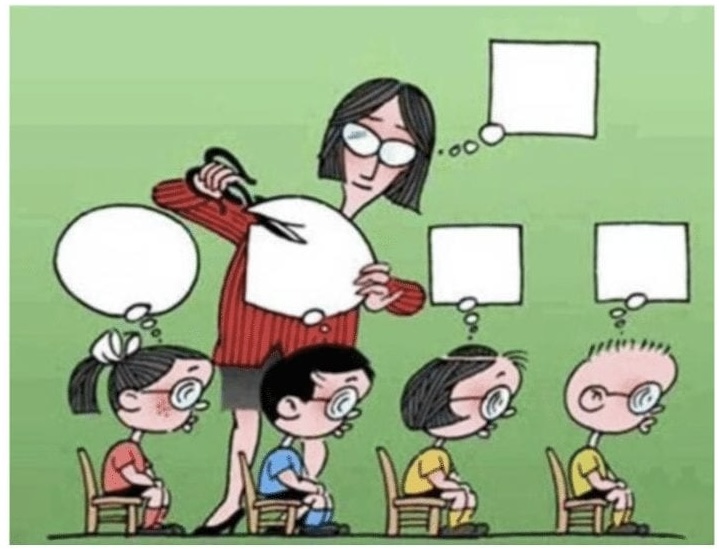
Retreived from: https://home.edweb.net/traditional-public-schools-win-competition-for-students/
One of the major claims that EdTech companies use to promote personalised education is that, by analyzing students’ data, they can create a tailored learning path that can enhance students’ educational outcomes, maximizing the efficiency of the educational system and reducing teachers’ workload. Deepmind’s statement promises something even better: a ‘genuine personalised learning… enabling students to create their own personalised ideas’(Deepmind, 2023). Since there is no further explanation, it is hard to argue against it. However, it is difficult to know if this is possible due to the lack of research on the efficacy of personalised learning. Moreover, following the ideas of Bourdieu, I cannot see how personalised education can help working-class students think that their culture background and ideas are valuable. Deepmind talks about personalised ideas but fails to acknowledge that not all ideas or culture background have the same value in our society.

Image Credit: RedPen/BlackPen[1]. Retreived from: https://lsepgcertcitl.wordpress.com/2018/05/13/the-imposter-syndrome-as-a-structural-problem/
Another point worth mentioning is Bourdieu’s concept of Habitus, as the philosopher explained it as a mindset or the value that we believe we possess. I have the impression that Deepmind and other tech companies talk about learning and education as a cognitive process without considering the social baggage that we carry, which may determine the choices we made or the aspiration that we have. If students are unable to socialize with students from different backgrounds, they are not going to be able to acknowledge and contest the dominant social and cultural capital. In order to change the status quo promoted by the current educational system, we need diversity, and I think personalised education promotes individualism and does not challenge the value of the social and cultural capital of the dominant class.
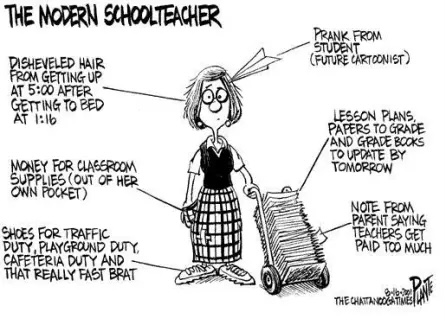
Retreived from: https://apclary.wordpress.com/2009/10/28/what-a-teacher-looks-like/
Another claim covered in Deepmind’s statement was that AI can support educators in reducing their workload. I agree that AI has the potential to do so, but the burden on teachers goes beyond workload. The profession needs to gain, in Bourdieu’s words, the social and economic capital they deserve. Every day, teachers give personalised education to their students, but sadly, society is falling to recognise its value.
Blibliography:
infed.org (2020). Pierre Bourdieu on education: Habitus, capital, and field. Reproduction in the practice of education. [online] Available at: https://infed.org/mobi/pierre-bourdieu-habitus-capital-and-field-exploring-reproduction-in-the-practice-of-education/ (Accessed: November 26th, 2023).


Leave a Reply