
Picture retrieved from National Museum of American History
For many years, the American psychologist B.F. Skinner researched and wrote about behaviour and learning. Skinner was convinced that humans do not function with free will; he believed that the learning process was based on changes in human behavior that were the result of external events. After observing one of his daughter’s classes, Skinner came to the conclusion that the traditional learning environment was not appropriate due to the diverse intellectual abilities of the students and the lack of instant feedback. Although not the first one in history, in 1954 Skinner created a teaching machine which was described by Abhishek Solanki as:
The teaching machine was composed of mainly a program, which was a system of combined teaching and test items that carried the student gradually through the material to be learned. The “machine” was composed of a fill-in-the-blank method on either a workbook or on a computer. If the student was correct, he/she got reinforcement and moved on to the next question. If the answer was incorrect, the student studied the correct answer to increasing the chances of getting reinforced next time (Solanki, 2019).
Skinner was convinced that this machine would not only provide instant positive feedback but also allow students to work at their own pace and learn more effectively. Many of its detractors argued that his theory failed to consider the role of the environment and biological factors. Listening to Skinner’s description of his teaching machine, it is possible to see the resemblance between his claims and the claims of Edtech companies regarding the benefits of personalised education. Unfortunately for Skinner, he did not have access to the students’ data to support his view or to disprove his views.

Sinicki, L. (2020) Retrieved from: https://lisasinicki.com/tag/pavlovs-dog/
Skinner’s theory, which regards learning as merely a process of conditioning within an environment of stimulus and punishment, has long been refuted. Nevertheless, teaching and learning have been influenced by his behaviorist approach. Teachers commend students for good behavior or positive responses, and it has been proven that the majority of students respond positively when given stickers, stars, or electronic badges as rewards for performing well. Simultaneously, when there is inappropriate behavior, students need to understand that there will be consequences. This may help not just to create the right conditions for learning but also may allow students to focus and learn content. Having said that, the purpose of education is more than just learning, as Biesta has argued.

Parisi, M. ‘The Truth about Pavlov’s Dog’ Retrieved from: https://www.offthemark.com/
Similar to how Skinner aimed to control and modify the behavior of students, as well as their learning process and outcomes, our society is influenced by digital technologies seeking to predict, control, and modify our behavior. Unlike Skinner, these new technologies are aware of the important of human’s emotions and responses, mining data from human interaction and machine to, as Watters (2017) writes, hijack our minds:
New technologies are purposefully engineered to demand our attention, to “hijack our minds.” They’re designed to elicit certain responses and to shape and alter our behaviors. Ostensibly all these nudges are supposed to make us better people… But much of this is really about getting us to click on ads, to respond to notifications, to open apps, to stay on Web pages, to scroll, to share – actions and “metrics” that Silicon Valley entrepreneurs and investors value (Watters, 2017)
Education has been significantly impacted by these actions and metrics. Knox, Williamson & Bayne (2020) point out that ‘the future of education may tend toward very specific forms of behavioural governance – a machine behaviorism – entailing a potent combination of radical behavioral theories and powerful machine learning systems that appear to work against any student autonomy’. More troublesome is the idea that this behavioural governance may include academic and non-academic learning targets. Talking about social-emotional learning, Williamson (2017) points out the effects of social- emotional learning focus in schools:
In sum, social-emotional learning is the product of a fast policy network of ‘psy’ entrepreneurs, global policy advice, media advocacy, philanthropy, think tanks, tech R&D and venture capital investment. Together, this loose alliance of actors has produced shared vocabularies, aspirations, and practical techniques of measurement of the ‘behavioural indicators’ of classroom conduct that correlate to psychologically-defined categories of character, mindset, grit, and other personal qualities of social-emotional learning (Williamson, 2017)
It is clear that the datafication of education ‘reflects the much broader narrative of ‘Silicon Valley solutionism’ which tends to frame data-driven work as an outside force, a revolutionary disruption capable of radically enhancing a particular sector or social practice with technology-fueled efficiency and precision’ (Knox et al., 2020). One may ask when does machine behaviorism have educational value and when it is potentially counterproductive to learning. In the same way that Skinner theories and finding, machine behaviorism may have something good, something bad and something ugly:
The good: In my experience as a secondary school teacher, some of the apps I use in lessons have provided me with insights into my students’ achievements. Using apps like BookWidgets or Kahoot, I am able to observe which students retain vocabulary better and identify those who require more assistance. Student engagement is great, and their attainment is even better. Microsoft Teams’ insight feature can generate data from my students’ engagement within a chat, enabling me to provide faster feedback. In the case of students with neurodiversity, digital technologies can offer better learning opportunities. Through apps like Flipgrid, students can create videos where they feel more inclined to speak. Additionally, being able to monitor the time they spend in apps like LanguageNut allows me to monitor the duration they took to do specific tasks, providing insights that help me target students who require more praise and encouragement.
The bad: If we rely too much on the data gathered from these digital technologies, we can lose sight of other important elements, as Skinner did. We cannot solely consider data and learning facts or formulas as the only indicators of success. Moreover, teachers can lose their role as educators and be reduced to mere mediators and data collectors, with no control over how to teach and what to teach. Biesta also highlights that if students are treated as consumers, they become subjects of a market-oriented type of education, being unable to exercise their freedom of choice (Logan, 2022). Finally, if data becomes the compass dictating the purpose of education, it will be reduced to mere ‘learnification’, controlled by market forces or, as Knox et al. (2020) established, succumb to ‘Silicon Valley solutionism’.
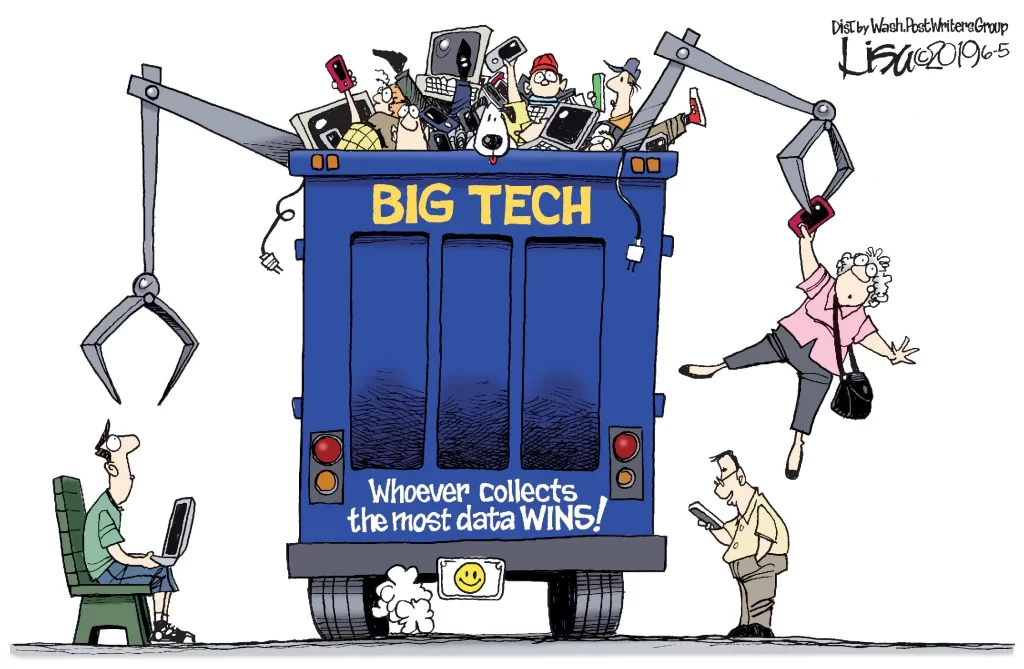
Lisa Benson cartoon. Tech companies loot data. From https://eu.savannahnow.com/story/opinion/cartoons/2019/06/09/lisa-benson-cartoon-tech-companies-loot-personal-data/4951096007/
The ugly: The ugly is, as Knox et al. (2020) wrote, to reduce education as an extreme form of behaviorism whose main aim is to ‘shape students’ choices and decision based on constant tracking and predicting of their behaviours, emotions, and actions’ and more importantly leave that power to companies whose solely objective is to gain more data, to profile consumers and to sell more.
Bibliography
Knox, J., Williamson, B. & Bayne, S. (2020) Machine behaviourism: future vision of ‘learnification’ and ‘datafication’ across humans and digital technologies. Learning Media and Technology. Vol 45 (1) 31-45.
Logan, T. (Host). (2022, March 14). Education and Freedom with Gert Biesta. Future Learning Design Podcast.[https://anchor.fm/futurelearningdesign/episodes/On-World-Centred-Education—A-Conversation-with-Prof–Gert-Biesta-e1cqcj5
Solanki, A. (2019, September 10). Skinner’s Teaching Machine. History of Education Timeline. Retrieved from: https://medium.com/history-of-education-timeline/skinners-teaching-machine-f3f0edaa6346
Watters, A. (Dec 23rd, 2017) Education Technology and the New Behaviorism. Hack Education: The History of Education Technology. Retrieve from: http://hackeducation.com/2017/12/23/top-ed-tech-trends-social-emotional-learning.
Williamson, B. (2017, August 29). Fast psycho-policy & social-emotional learning. Code Acts in Education. Retrieved from: https://codeactsineducation.wordpress.com/2017/08/29/fast-psycho-policy/


Leave a Reply to paolamartinezromero Cancel reply