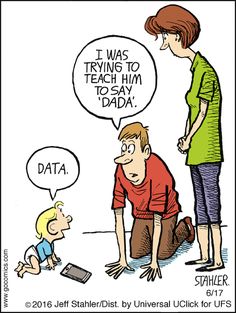
From: ©2016 Jeft Stahler/Dist. by Universal UClick for UFS
One of the major claims that EdTech companies use to promote personalised education is that, by analysing students’ data, they can create a tailored learning path that can enhance students’ educational outcomes, maximising the efficiency of the educational system and reducing teachers’ workload. However, personalised learning poses several issues, ranging from data privacy concerns to a lack of research proving the efficacy of this system. Personalised education bases its efficiency on data and artificial intelligent systems that can analyse students’ attainment or even emotions in order to create a customised education product that they claim to be effective. Softwares like MathSpring (formally known as Wayang Outpost ) or 4 Little Trees claim that by detecting emotions in students, they can lead to better and more efficient personalised education.
If the idea of using emotions interpreted by AI to create a better student learning outcome seem a transgression to personal boundaries, the article written by Ben Williamson (2020) titled ‘Bringing up the bio-datafied child: Scientific and ethical controversies over computational biology in education,’ takes the idea of personalised education to a different and more troublesome level. After reading the article, I could not stop thinking about the idea of sociogenomics affecting not just education, but the life expectations of a person. Citing Youdell and Lindsey (2018) and Comfort (2018), Williamson underlines that, ‘Sociogenomics expertise in education… raises ethical concerns about biological determinism and eugenics, reanimating longstanding debates about the genetic inheritance of intelligence… [with] potential discriminatory practices on children.’ (2020). In the same article, Williamson also points out how data and algorithms are changing the way we understand life and how they can affect the upbringing of children, using genetics as a parameter in the same way as environment and socioeconomic status to predict a child’s learning abilities.
In another article written by Williamson, ‘Genetics, big data, and research in postgenomic education’, the author quotes the findings of a study conducted by the Social Science Genetics Association Consortium. SSGAC established that ‘genetic patterns across a large population are associated with years spent in school, [and a]ccording to its 80 authors, educational attainment is moderately heritable and an important correlate of many social, economic, and health outcomes’ (2018). In other words the SSGAC, establishes that educational outcomes can be as hereditable as illnesses.
As the title of Williamson’s (2020) article suggests, the idea of bringing up a bio-data-field child is troublesome. I would like to focus on the use and interpretation of data. As we already know data, bio-data and algorithms can be subjected to bias interpretations.
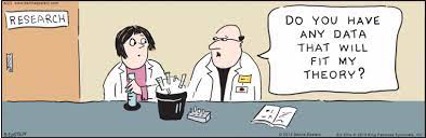
From: Today’s Six Chix strip
As Mark Xiang writes:
Due to the innate nature of biases within humans, biases are reflected in all data that exists in the world. With the increasing popularity and accessibility of Machine Learning and big data; there exists an unimaginable depth of data and accessible tools in the world. With all this data, there exists ways that bias influences data and our inferences. Biases do not just exist only within the data, there are also in cognitive biases that a scientist may have while performing research, experimenting, or implementing algorithms (Xiang, 2019)
Considering this bias, one could argue that sociogenomics and bioinformatics might lead to dramatic and negative changes in the educational system based on students’ DNA or genetic predisposition. Even if, in the future, it is proven beyond any doubt that academic attainment is linked to genetics, we need to remember that the purpose of education goes beyond academic achievement. As G. Biesta established, the purpose of education should encompass three domains: Qualification, Socialization, and Subjectification (2020). It seems that personalised education, whether based on Sociogenomics, bioinformatics, or just pure data from edtech, leads to Qualification or Socialization but not Subjectification.
In addition and considering the article written by Roberts-Mahoney, Means & Garrison ’Netflixing human capital development: personalized learning technology and the corporatization of K-12 education’ where the authors analyse the language use to support the use of personalised learning in secondary schools in USA. They established that ‘personalised learning is based in the necessity of the market orientated society and the private interested of corporate control’. The authors also concluded that personalised education could only consider qualification as coined by Biesta (2020) due to ‘the expansion of data-driven instruction and decision-making, while conceptualising learning as the acquisition of discrete skills and behavior modification detached from broader social contexts and culturally relevant forms of knowledge and inquiry (Robert-Mahoney, Means and Garrison, 2016).
The writer and education advocate Alfie Kohn, in his article published in The Washington Post, gives ‘Four reasons to seriously worry about personalized learning’, also points out that from time to time, corporations have embraced the concept of customised mass-produced commodities. Kohn argues that personalized learning is essentially an “’oxymoron’ because what’s customized is mass-produced – which is to say, standardized. Authentic personal learning isn’t“ (Kohn, 2015). Another aspect that Kohn underlines is importance of the Socialization and Subjectification in the learning process:
[I]n the best student-centered, project-based education, kids spend much of their time learning with and from one another. Thus, while making sense of ideas is surely personal, it is not exclusively individual because it involves collaboration and takes place in a community. Even proponents of personal learning may sometimes forget that fact, but it’s a fact that was never learned by supporters of personalized learning. (Kohn, 2015)
In fact, it is shocking how little academic research exists about the positive effects of personalised learning. It seems that personalized learning is merely a justification for the privatization of education, whose sole purpose is to equip students with skills. Since data and algorithms can be biased, personalized learning may also exhibit bias (Taylor, 2022). As Caroline Pelletier in her article ‘Against Personalised Learning ‘ established , Who will regulate what is worth learning? How will it promote equality? (2023). Moreover, Who will regulate student frustration or lack of motivation? How will students learn that sometimes they cannot choose what they want to learn or do? Will teachers have a role beyond being data extractors or facilitators? There are numerous questions that I am certain personalised learning would not be able to answer but I am also sure that greedy corporations would be able to use the data to justify the effectives of their products . So, based on the above discussed who could argue in favour of this unproven personalised learning?
Bibliography :
Biesta, G. (2020). ‘Risking Ourselves in Education: Qualification, Socialization, and Subjectification Revisited.’ Retrieved from: https://www.pure.ed.ac.uk/ws/portalfiles/portal/154917688/BiestaET2019RiskingOurselvesInEducation.pdf
Devlin, H. (2023, May 1). ‘AI makes non-invasive mind-reading possible by turning thoughts into text.’ The Guardian. Retrieve from: https://www.theguardian.com/technology/2023/may/01/ai-makes-non-invasive-mind-reading-possible-by-turning-thoughts-into-text
Hallam, S. & Parsons, S. (2013) ‘The incidence and make up of ability grouped sets in the UK primary school’, Research Papers in Education, 28(4), pp. 393-420. DOI: 10.1080/02671522.2012.729079
Mithen, S. (2018, October 24). Blueprint by Robert Plomin review – how DNA dictates who we are. The Guardian Newspaper. Retrieved from https://www.theguardian.com/books/2018/oct/24/blueprint-by-robert-plomin-review
Penalva, J. (2020) Innovation, personalised education and Little Red Riding Hood. International Journal of Lifelong education, 39:4, 339-355, DOI: 10.1080/02601370.2020.1786178
Pelletier, C. Against Personalised Learning. Int J Artif Intell Educ (2023). https://doi.org/10.1007/s40593-023-00348-z
Roberts-Mahoney, H., Means, A. J., & Garrison, M. J. (2016) ‘Netflixing human capital development: personalized learning technology and the corporatization of K-12 education’, Journal of Education Policy, 31(4), pp. 405-420. DOI: 10.1080/02680939.2015.1132774.
Taylor, S. (2022, April 9). Book Review: Technology Is Not Neutral: A Short Guide to Technology Ethics by Stephanie Hare. Retrieved from: https://blogs.lse.ac.uk/impactofsocialsciences/2022/04/09/book-review-technology-is-not-neutral-a-short-guide-to-technology-ethics-by-stephanie-hare/
Wang, H., King, R. B., & McInerney, D. M. (2023) ‘Ability grouping and student performance: A longitudinal investigation of teacher support as a mediator and moderator’, Research Papers in Education, 38(2), pp. 121-142. DOI: 10.1080/02671522.2021.1961293.
Williamson, B. (2018) ‘Genetics, big data, and research in postgenomic education’. Retrieved from https://codeactsineducation.wordpress.com/2018/07/26/postgenomic-education-research/
Williamson, B 2020, ‘Bringing up the bio-datafied child: Scientific and ethical controversies over computational biology in education’, Ethics and Education. https://doi.org/10.1080/17449642.2020.1822631
Xiang, M. (2019) ‘Human Bias in Machine Learning’, Towards Data Science, March 18, 2019. Retrieved from https://towardsdatascience.com/bias-what-it-means-in-the-big-data-world-6e64893e92a1


Leave a Reply to paolamartinezromero Cancel reply